PRODUCTION GUIDE · PUBLISHED AUGUST 30, 2026
Vadoo AI Faceless Video Workflow: Building a Channel With Sources, Voice and Visual Discipline
An original 1017-word guide to faceless video production and publishing, written for publishers creating repeatable narrated videos without an on-camera host.
1. Define the production question
The useful decision concerns faceless video production and publishing. Vadoo AI should be evaluated against a concrete production decision, not a gallery of isolated outputs. To make that decision concrete, consider a weekly five-minute explainer series that must sound consistent, cite sources and avoid generic stock repetition. That scenario is narrow enough to expose whether the workflow preserves intent across generation, revision and delivery. It also prevents a common review error: changing the brief whenever the tool produces something attractive. The official product source is the authority for current access and features; this independent guide concentrates on planning and evidence.
2. Prepare inputs with one job each
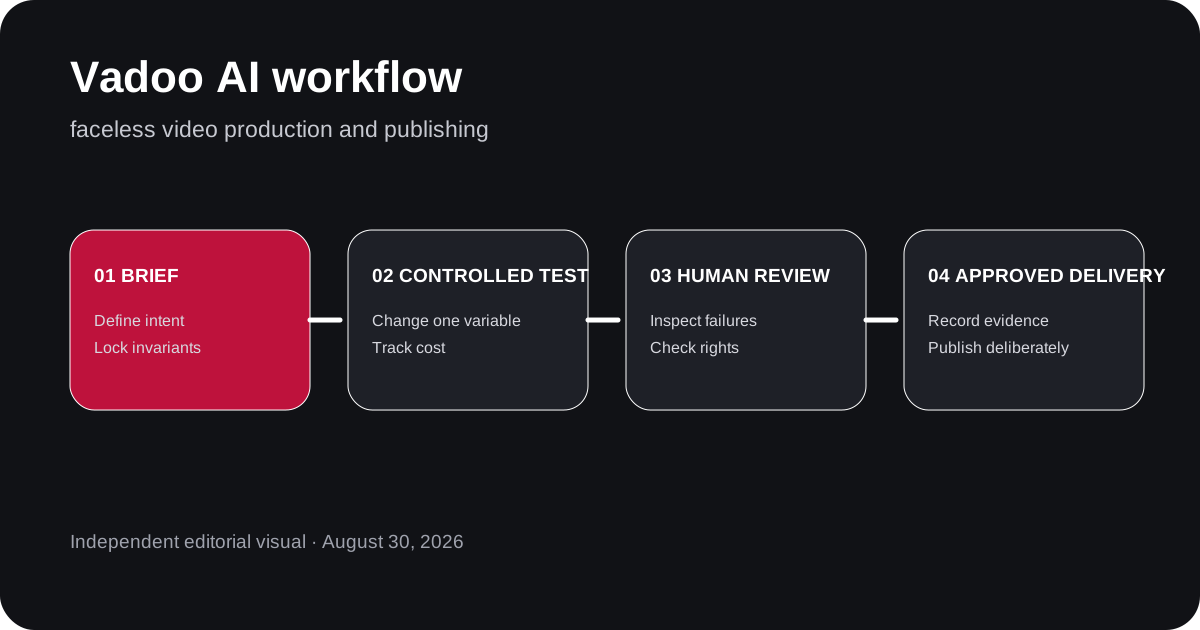
Before generation, collect a researched outline, source links, original script, voice direction, visual motif, B-roll plan and channel style guide. These inputs should be written into a one-page brief before any credits are spent. Every item needs one job. A reference may anchor identity, a script may establish timing, and a delivery matrix may define crop and caption needs. When one input is expected to solve several contradictory problems, the output becomes difficult to diagnose. Save the original assets separately so later enhancement or editing can always be compared with an untouched source.
Use the focused keyword workflow, step-by-step tutorial and broader guide to prepare the test.
3. Order the controls
Do not adjust everything at once; sequence hook, chapter pacing, narration tone, B-roll relevance, caption rhythm, music level, thumbnail promise and publishing cadence. Treat them as a sequence rather than a pile of options. Lock the invariant requirements first, choose the simplest viable route second, and add expressive detail only after the first result proves that the foundation works. This order matters because AI image generation and AI video generation are probabilistic. A complicated prompt can hide which instruction caused a useful improvement or a costly failure.
4. Run a fair test matrix
Create a small test matrix. Keep the deliverable, source material, output ratio and acceptance criteria fixed. Change one variable at a time: the model, reference strength, motion instruction, or finishing stage. Name every result with the date and variation. Then compare candidates at the size and device where the audience will see them. A thumbnail can conceal edge defects, while a full-screen preview can exaggerate problems that are irrelevant to a small social placement.
5. Write failure into the brief
The review gate must catch unsourced claims, repetitive visuals, robotic emphasis, misleading thumbnails, reused scripts, weak disclosure or automation that removes human fact-checking. Write these risks into the review sheet before generation. A reviewer should be able to mark each one as absent, repairable or disqualifying. This is more useful than a vague score for “quality.” It also makes retries purposeful: if the failure is caused by the source image, changing models may waste money; if the failure is caused by motion language, rebuilding the source frame may waste time.
6. Measure approved-output cost
Judge value per approved deliverable. Count prompt exploration, failed generations, premium routes, enhancement, audio passes, exports and human cleanup. A plan that appears inexpensive can become costly when only one result in twenty survives. Conversely, a higher-priced route may be economical when it produces an editable first draft quickly. Recheck live pricing and credit rules on the official Vadoo AI site because plan names, limits and model availability can change after this publication date.
Review the pricing explainer and current official terms before committing credits or a subscription.
7. Treat rights as a production control
Rights and provenance belong inside the workflow. Use only material you can lawfully upload, obtain consent for recognizable people and voices, and avoid implying that a synthetic scene documents a real event. Record where references came from, which tool and model produced the asset, and who approved publication. If the project contains product claims, health claims, financial claims or quotations, the visual result does not verify them. A human editor must compare the final script and captions with the underlying evidence.
8. Keep an evidence trail
Approval should leave behind for this scenario is research notes, citation map, script history, voice review, shot ledger, thumbnail test and final editorial sign-off. That record turns a creative experiment into a repeatable system. It allows another editor to reproduce the chosen route, understand why other candidates were rejected and update the work when a model changes. It also keeps a team from rewriting history after a lucky output. Production knowledge lives in the prompt, source, settings, rejection reason and final context—not in the exported file alone.
9. Compare routes without moving the goalposts
Compare alternatives with the same brief. Keep inputs, duration or dimensions, review criteria and spending ceiling stable. Separate foundation-model behavior from the surrounding interface: a result can fail because of the model, a wrapper's limited controls, the prompt, or the source asset. Compare at least one official provider route and one broader multi-model workspace. Do not turn the test into an unsupported universal ranking; the useful conclusion is which route fits this particular bottleneck.
For context, compare the model directory, alternatives guide, the generative AI overview, and OpenAI's official research and products.
10. Design the handoff
Internal handoff is where many AI projects lose quality. Give the editor the source assets, selected output, rejected examples, prompt record and intended crop. Give the reviewer a short checklist instead of an open-ended request for feedback. Give the publisher the rights record, disclosure decision, captions and final channel specification. Those handoffs make faceless video production and publishing accountable. They also keep downstream staff from “fixing” an approved invariant while solving a different problem.
11. Run the final quality pass
Before publication, inspect the result without sound, then listen without picture. Check the first and last frame, names, text, logos, faces, hands, object permanence, reflections, cuts and caption timing as relevant. Review accessibility: captions should be accurate, contrast should be sufficient and important information should not depend only on color or audio. Finally, ask whether the asset delivers the promised information or merely demonstrates that an effect can be generated.
12. Make a bounded decision
The decision is not whether Vadoo AI is good in the abstract. It is whether the current official workflow can produce a weekly five-minute explainer series that must sound consistent, cite sources and avoid generic stock repetition within the team's quality, rights, time and cost boundaries. Start with the smallest meaningful test, preserve evidence, and stop when repeated revisions no longer improve the acceptance score. Use the accompanying keyword guide, tutorial, pricing notes and model directory to plan the test, then verify every time-sensitive fact with the provider before committing production volume. Record what the team learned in plain language so the next brief begins with evidence instead of repeating the same exploration.
CONTROLLED TEST
Put the brief into practice.
Keep the acceptance criteria visible, document every retry and use a human approval step before publication.
Create with Polox AI ↗